What to do next with aging wind farms is becoming an increasingly important question. As the first grid-scale onshore wind farms reach the end of their operating lives, the number of turbines requiring decommissioning is expected to triple by 2030. Alongside regulatory changes and new grid connections in Great Britain, this makes the options for aging sites increasingly critical.
Owners must evaluate the future of their asset. The main strategic options are:
- Life Extension (LTE)
- Decommissioning
- Repowering
In practice, the preferred end‑of‑life pathway depends on how constrained the development environment is. In an unconstrained scenario — where consenting is straightforward, grid reinforcement is readily available, and larger turbines can be procured at low CAPEX with short lead times — repowering is often the default option. However, consenting, grid access, turbine availability and project economics are frequently constrained in reality, so the choice between repowering, life extension and decommissioning becomes site, and owner specific.
Natural Power can support owners through this decision process and delivery, drawing on experience across repowering, life‑extension execution and the operation of ageing sites.
Industry sources consistently highlight repowering as a major opportunity to increase output, reduce O&M costs, and align with energy-transition targets—though it comes with its own challenges.
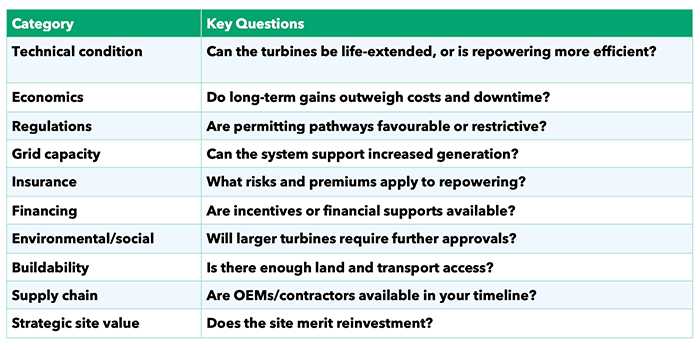
Below are the critical factors to assess, supported by the latest available evidence.
1. Technical condition & lifetime extension potential
Before repowering, assess the feasibility of extending the existing asset’s life:
- LTE programmes involving minimal intervention to the major turbine components can add up to 10 years of additional operations.
- There is a trilemma of trade-offs between revenue opportunities, CAPEX and other challenges with Repowering and OPEX cost and obsolescence with LTE.
- There is no single industry standard approach to life extension. A structured assessment of risks, remaining useful life and required interventions is therefore essential.
- In the UK, HSE involvement in aging assets is increasing. IEC 61400‑28 (currently published as a Technical Specification rather than a full standard) is commonly referenced as a guide, and there have been early cases where HSE has issued letters relating to life extension.
Key questions: (1) How do you ensure safe operation beyond design life? (2) How do you ensure profitable operation given changing performance and cost profiles?
2. Economic viability & cost–benefit analysis
Repowering typically offers far greater long-term gains than continuing with aging assets:
- Newer turbines are larger, can generate more electricity and more reliable, reducing OPEX costs.
- Repowering can reduce turbine count by ~25% yet increase installed capacity by 2.7× and electricity production by 3×.
- Continuing to “sweat” old assets increases the probability of component failures and downtime.
- As assets age, OPEX typically increases while AEP can decline. Revenue support may also change (e.g., the end of ROCs), materially affecting the life extension business case.
- These dynamics are driving a more specialised ownership market, with some owners exiting ageing assets to recycle capital into lower risk greenfield development, while specialist operators acquire older sites and manage them actively.
- Value can often be unlocked through improved OPEX forecasting, robust PCYA modelling, and reviewing alternative O&M strategies (including non‑full‑scope operating models). Even where an owner intends to sell, additional technical and commercial work during vendor due diligence can support stronger valuations.
Key question: Does repowering generate significantly higher long‑term value than maintaining ageing turbines (once CAPEX, downtime, OPEX, performance decline and revenue support are accounted for)?
3. Regulatory & permitting constraints
Repowering is heavily dependent on the local and national planning regulations, the political attitude to positive renewable energy policy implementation, and the proximity to sensitive receptors. New turbines are typically taller and more powerful than the original units they replace. Increases in the blade length, size of hard stand areas, larger turbine foundations and larger separation distances all result in more land take, and therefore more disturbance to habitat.
- Careful design is required, particularly around cut and fill and the challenges associated with this for engineering, landscape and habitat loss.
- Taller turbines can result in significant landscape and visual impact beyond the local area. Visual amenity challenges due to increase in height and proximity to residential properties, are also core to design decisions.
- Abnormal Indivisible Loads (AILs) create the greatest challenge for access onto and within a site for larger turbines. AILs transport the largest components such as blades and tower pieces from port to site. Due to the size and weight of the loads the width of the access points, pinch points along the route and gradients of the road network need careful consideration.
Key question: What are the permitting timelines and constraints in your jurisdiction, and how do they impact project planning?
4. Grid capacity & infrastructure requirements
New turbines typically have higher capacity and different grid profiles:
- Repowering may require transformer upgrades, grid reinforcement, or new cabling, depending on the new turbine specifications.
- Some sites may face export capacity limits that restrict repowering potential.
Key question: Can the existing grid infrastructure and connection agreement accommodate higher output and different compliance requirements for repowered turbines?
5. Financing & investment considerations
From a finance and lifecycle perspective:
- Repowering is increasingly supported by policy incentives (e.g. EU repowering support schemes).
- End-of-life pathways include:
- Life extension
- Decommissioning
- Repowering
as outlined by legal and financial analysts.
- Repowering improves long-term asset bankability due to higher reliability and output.
Key question: What financing structures, incentives, or revenue mechanisms are available to support the preferred end‑of‑life pathway?
6. Environmental & social impact
- Repowering yields major sustainability gains without the introduction of new sites in a local area.
- Local acceptance tends to be higher as communities are already accustomed to wind infrastructure.
However:
- Larger turbines may require further justification in terms of the iterative design process, and environmental mitigation.
- There are wider industry discussions around how repowering schemes are assessed and how we can mitigate the impact on a potentially valuable restored peatland and habitats. This includes understanding the peatland baseline situation at an earlier stage to inform the quality and quantity of peat that could be impacted.
- In terms of social impact, better informed community consultation is key to bringing a community along the design and decision making process.
Key question: Will the proposed repowered layout meet environmental requirements and community acceptance expectations?
7. Supply chain & project scheduling
- Europe must install 250 GW of new wind by 2030; repowering contributes a potential 65 GW. Supply chain bottlenecks are therefore critical.
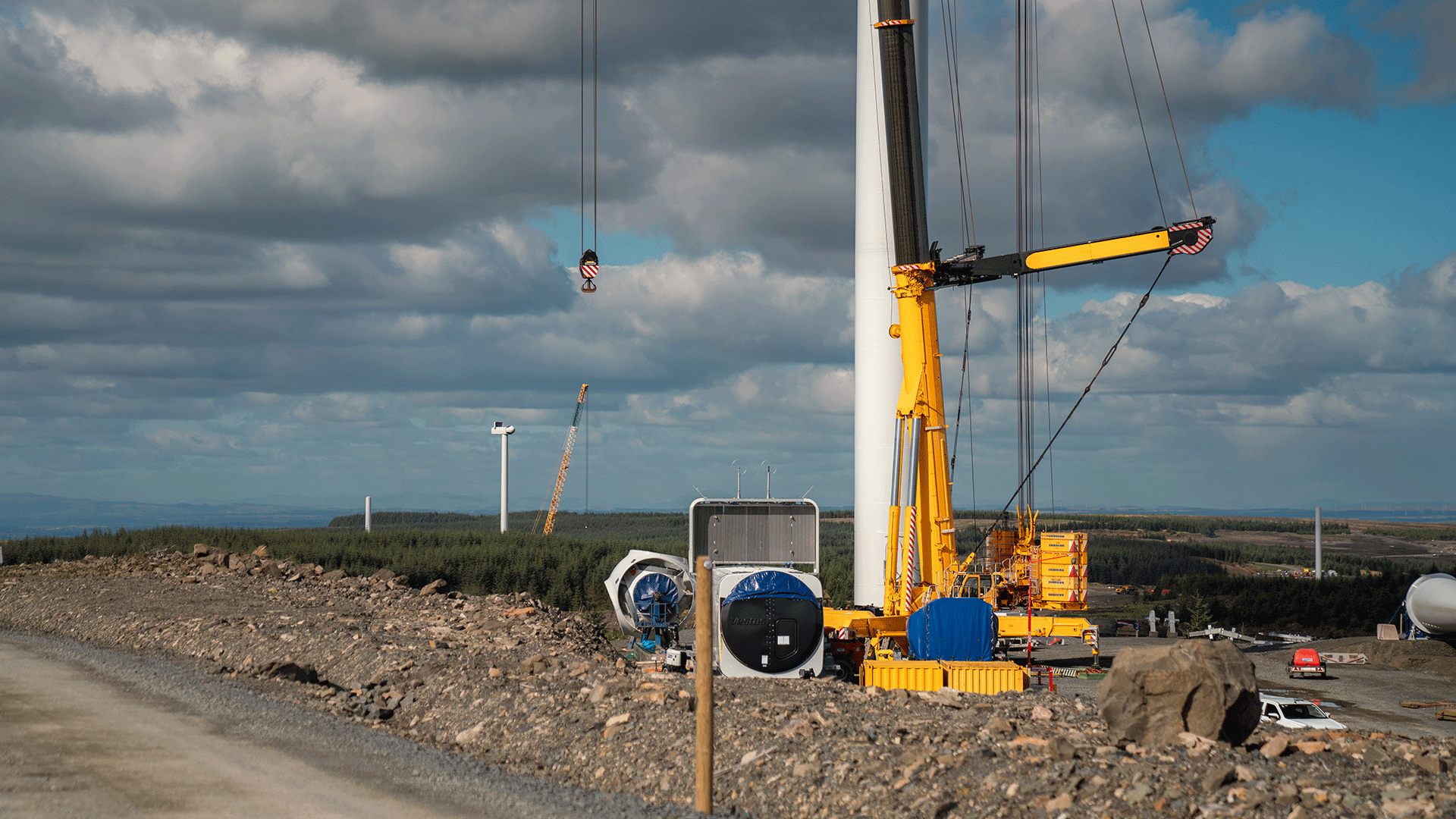
- Availability of larger, modern turbine models and crane equipment can affect project timelines.
Key question: Are OEMs and contractors available when needed, and how does this affect programme and outage planning?
8. Strategic site value
Older wind farms are often located in the best wind resource locations, making them excellent repowering candidates:
- Modern turbines can unlock significantly more energy from the same site.
Key question: Does the site merit reinvestment, given wind resource, constraints, and the strategic value of the grid connection?
Summary: Factors to evaluate at end-of-life