
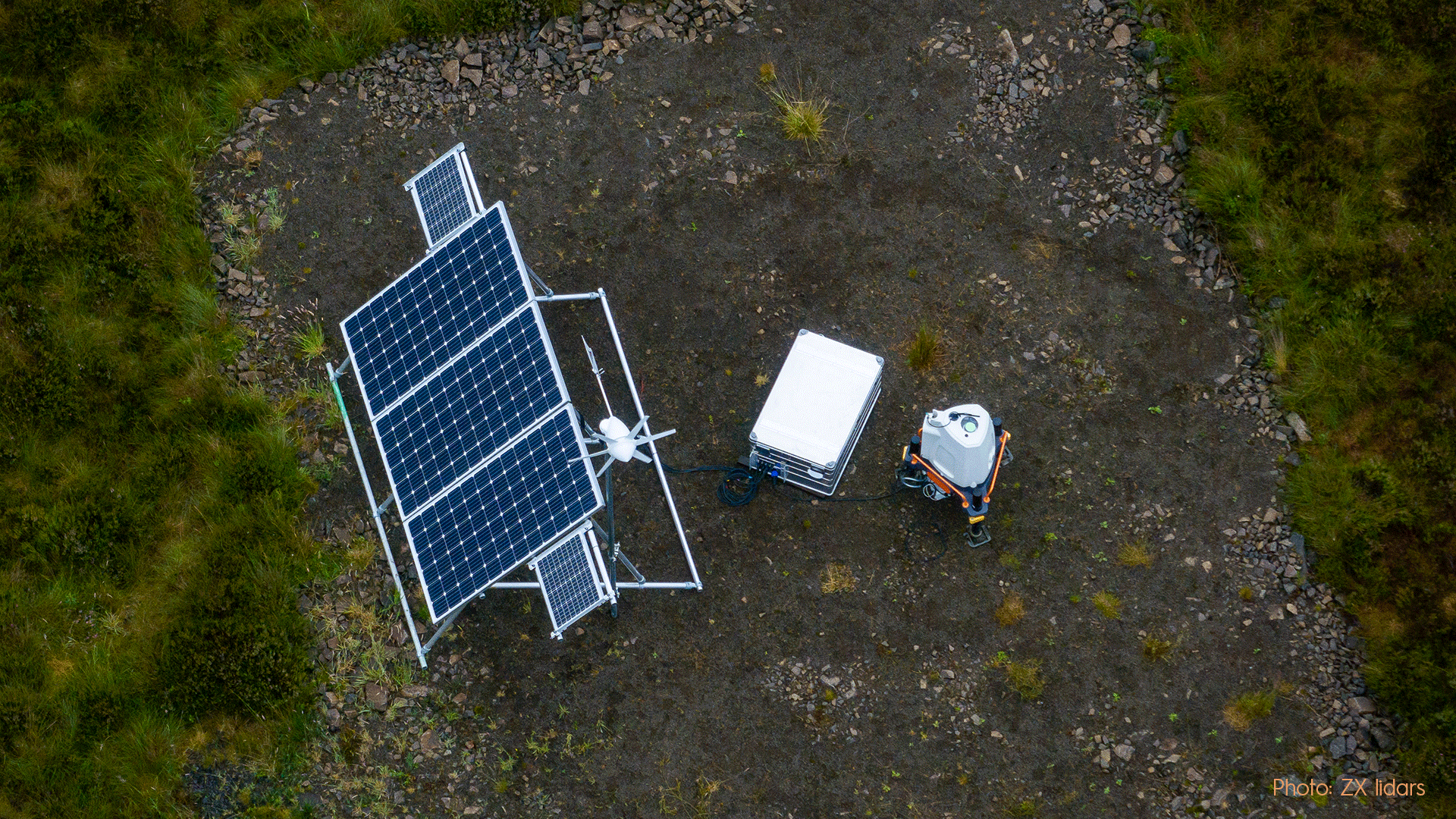
At Natural Power, we are frequently asked for our perspective on the use of vertical‑profiling lidar for wind resource assessment, here’s a summary of our views.
Natural Power’s view is that modern, well‑validated vertical‑profiling lidar systems provide accurate, flexible, and widely accepted wind measurements that can replace or complement meteorological masts for pre‑construction wind resource assessment and other project development activities such as turbine suitability.
Offshore and in simple terrain, standalone lidar deployments have been extensively validated and are considered bankable by most financing institutions. These systems deliver high‑quality measurements of wind speed and direction at and above hub height, providing valuable insight into vertical wind structure, including shear and veer, across the rotor span of modern wind turbines.
In complex terrain, lidar remains a powerful and valuable measurement tool when combined with appropriate site selection and expert analysis. In such environments, met‑tower‑equivalent performance is typically achieved through the application of CFD‑based flow modelling to account for terrain‑induced flow complexity. Natural Power routinely applies its Dynamics+ methodology, which provides robust volume‑to‑point conversion and interrogates the flow field across the full lidar scan volume to assess variability in wind speed, turbulence, inflow angle, and wind direction. This approach has been validated in highly complex terrain through multiple mast–lidar co‑location campaigns.
Complex forested sites similarly benefit from careful lidar deployment and expert interpretation. While such sites may exhibit localized flow features, short‑term lidar campaigns, when appropriately designed and analyzed, can significantly reduce the need for extensive mast infrastructure while still providing high‑confidence resource characterization.
As with any wind measurement technology, the value of lidar lies in how it is used. Ongoing industry initiatives—including further reductions in turbulence measurement bias, improved understanding of data recovery under challenging meteorological conditions, and robust factory and field verification—continue to strengthen confidence in lidar data. When deployed with appropriate verification, correction, and expert oversight, lidar is a reliable and mature tool for understanding wind resource at project sites and supporting project development and financing decisions.
Natural Power has been involved with lidar since its early introduction into the wind industry and brings nearly 20 years of experience in extracting maximum value from these measurements. Our focus is not simply on collecting data, but on ensuring that lidar is used correctly and effectively to support high‑quality wind resource assessment, yield analysis, site suitability evaluation, and investment confidence.