
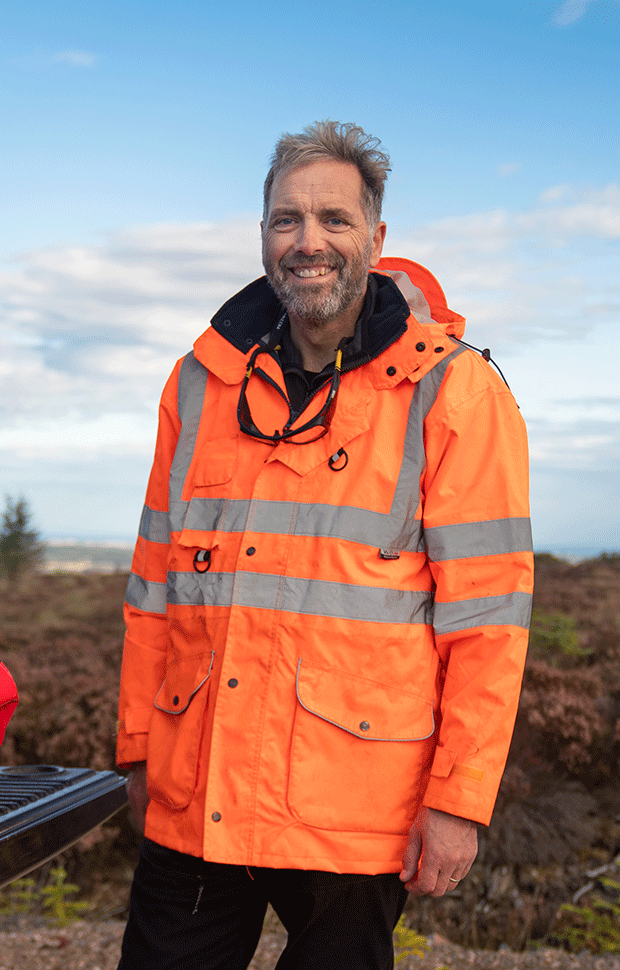
Jim Blaikie
When did you join Natural Power?
2019
Can you tell us more about your role?
I work in the Hydrology department of Consenting & Environment (C&E), and I specialise in peatland environments, with expertise in the planning and delivery of peatland condition surveys, peatland restoration feasibility assessments, peat coring and analysis. I have experience in the specification, supervision, and implementation of peatland restoration techniques in peatland environments. I have a strong background freshwater hydrology including field monitoring, data interpretation and integration with peatland systems. All of this basically means I get to wander in the great outdoors taking samples and gathering data in the natural environment.
Why did you want to join the renewable energy industry?
I’m a qualified Environmental Scientist who loves and cares passionately about our natural environment, so it seemed a natural progression for me to become involved in the renewable energy sector.
What is the most challenging part of your role?
Plantation forestry can be a very challenging environment to work in, whether it be surveying and navigating in dense forestry or walking over newly felled areas, which present various trip and slip hazards.
What is your favourite aspect of renewables?
The fact that I take personal pride in playing a small but meaningful part in supporting climate change mitigation and environmental restoration through my role as an environmental consultant.
What has been your proudest achievement?
I was a lecturer at Stirling University, teaching Environmental Science for 11 years, and seeing one of my students go on to complete her PhD was a very proud moment for me. Completing the ‘Munros’ was also a proud achievement.
Tell us something interesting about yourself (do you have a hidden talent or a quirky fact?)
I think I was destined to be interested in peatlands as my school was built on peatlands and it sunk a couple of cm each year until they had to demolish it (not with me in it of course).
What inspired you to learn more about peat and work in an environmental role?
I’ve always had a keen interest in the natural environment, but through extensive study during my degree and PhD I learned how important peatlands are in regulating climate. I took inspiration from one of my lecturers who had been working on climate change in Patagonia for the last 20 years. I also thought it would be a very cool place to do fieldwork. I wasn’t wrong!
Could you provide some background information on your PHD and what you learned from this experience?
I researched climate change in Patagonia since the last ice-age. Patagonia (southern South America) is the most southerly landmass on earth, out with Antarctica, so is more sensitive to the effects of climate change. Peat bogs are environmental archives of atmospheric conditions, and I studied fossilised pollen grains that were deposited in peat bogs. Therefore, when I extracted cores from peat bogs, I took samples from all the layers and radiocarbon dated them to establish when they were deposited. I then looked at thousands of prepared slides under a microscope to identify the species of pollen, which meant I knew what type of vegetation was growing in a specific location at a determined time. From that I could infer spatial and temporal climatic conditions which I could feed into global climate change models. From this I learned that by improving our understanding of peatlands, we can support their restoration as major carbon stores, helping to slow and partially offset the impacts of ongoing climate change.
What do you think the biggest challenges will be for peatland management in the future?
Peatlands are the most important terrestrial carbon store. Therefore, peatland management is becoming more important, but also more complex and faces several major challenges in the future. One of the most challenging is climate change itself, as warmer temperatures and changing rainfall patterns can lead to peatlands drying out. This increases oxidation and ultimately carbon loss back into the atmosphere; changing peatlands from carbon sinks to carbon emitters. The increased carbon released to the atmosphere then intensifies climate change, which leads to increased drying of peatlands and the release of more carbon into the atmosphere. This is called a positive feedback loop which is a self-reinforcing cycle that amplifies change.